
National Trends in Human Milk
& Infant Formula Management
Learn Six Trends Leaders Should Focus on Now
Managing human milk and formula is more complex than ever. What’s working? And where do gaps still exist?
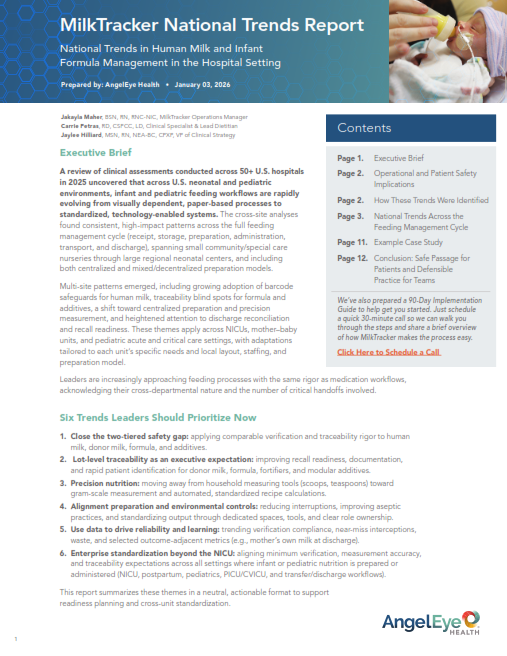
We are sharing findings conducted in 2025 from 50+ onsite hospital feeding-safety assessments. Drawing on these assessments, MilkTracker’s clinical team identified recurring patterns and operational gaps that often differentiate high-performing programs from those facing higher risk and found that feeding workflows are shifting from manual, visual processes to standardized, technology-enabled systems designed to reduce risk and support staff.
We’ve distilled these insights into a National Trend Report and a Visual Summary Report to help nursing leaders strengthen feeding safety, streamline workflows, and lead change with confidence.
Meet The Experts

Carrie Petras
RD, CSPCC, LD
As a Registered Dietitian with over 20 years of experience, Carrie is deeply passionate about the well-being of tiny babies and their families. She has extensive knowledge of neonatal nutrition, the use of human milk in the hospital setting, and enhancing nutritional support for premature infants. Carrie brings clinical experience to AngelEye, having worked at Norton Healthcare, Park DuValle Community Health Center, and the University of Louisville Hospital.

Jakayla Maher
BSN, RN, RNC-NIC
As Operations Manager for MilkTracker, Jakayla oversees the implementation and support of the MilkTracker solution. She joined AngelEye in 2023 and brings a deep passion for the NICU and family centered care from her nursing career at facilities in Washington, DC, and Colorado. She brings diverse healthcare experience beyond nursing, including EHR implementation, hospital mergers, and a focus on nursing satisfaction and efficiency.
National Trends You Can’t Ignore – Watch our 2-Part Webinar Series
Why Milk Tracker At a Glance
Beyond the EHR: Workflow Process
Where MilkTracker Bridges the Gap in Safety – Every Feed, Every Time.
Why Choose AngelEye Health?
review a Detailed Features Comparison to discover the difference.
Find the Right Partner, a checklist.
How do you choose a Feeding Management solution that best fits your unit’s needs?
Beyond the EHR workflow process